How Chinook Events and Microbursts Load Denver Commercial Roofs Differently
Wind damage documentation and repair for Denver commercial flat roofs - Chinook downsloping events, microburst membrane edge lift, fastener pullout, and ridge-pattern tears documented for Colorado insurance claims.
Denver's wind environment is unlike any other major US commercial market. Chinook downsloping events push sustained gusts exceeding 60 mph along the Front Range from October through March. Spring and summer microburst outflows drive 70-plus mph concentrated loads on commercial buildings across Adams and Arapahoe counties. We read the failure patterns these events leave on flat commercial roofs and build documentation that captures what actually happened.
Denver's Chinook wind pattern is the defining non-hail weather driver for commercial roof damage on the Front Range. When Pacific weather systems cross the Rockies and the air descends toward the plains, the downsloping acceleration produces sustained wind events that differ fundamentally from the sharp convective gusts of a summer thunderstorm. Chinook events run for hours, sometimes days, driving sustained load on membrane perimeters, parapet flashings, and edge metal that fatigues attachment systems in ways a single high-velocity gust does not. The January and February Chinook events that periodically hit Denver with recorded gusts exceeding 80 mph at DIA and 100 mph at foothills weather stations produce membrane edge damage on commercial buildings across the metro's western corridors - Lakewood, Wheat Ridge, Arvada, Westminster - where open-terrain wind-exposure categories apply.
Microburst outflow from summer thunderstorms produces a different failure pattern. A microburst descending over the DTC or the Aurora industrial corridor generates a concentrated radial wind pattern that loads roof corners and edges from multiple directions in rapid sequence. Buildings with mechanically attached TPO and perimeter fastener rows that have seen thermal cycling fatigue are particularly vulnerable - the membrane flaps, fatigues along the fastener row, and produces the linear ridge-pattern tear that is the signature of microburst membrane failure.
We build wind damage documentation packages for both event types. The scope shows what happened, where it happened, what the pre-event attachment condition looked like, and what repair or replacement is warranted - in a format your adjuster can use to move the claim without necessarily walking every linear foot of damage.
Chinook downsloping loads a commercial roof primarily through sustained corner and perimeter uplift. ASCE 7 maps flat-roof zones into field, perimeter, and corner zones where corners carry roughly three times the design uplift pressure of the field. Chinook events sustaining 60-plus mph gusts for two to four hours drive cumulative fatigue at perimeter fastener rows and seam adhesion at termination bars that a 90-mph thunderstorm gust lasting seconds does not. Buildings on Denver's western slope exposure - Lakewood's Belmar district, Arvada commercial corridors along Wadsworth, Westminster retail along Federal Boulevard - are regularly in this event zone. Membrane systems that were installed at the field fastener density rather than the elevated perimeter density required by the wind-uplift calculation for their exposure category are the ones that fail in these events.
Microburst outflow events load the roof in a rapid multi-directional pattern. A microburst descending over a flat commercial building - common in the I-225 corridor, the DTC, and the Aurora eastern suburbs during the July and August monsoon moisture pattern - generates outflow that hits the roof from multiple vectors before the building structure can shed the load from any one direction. This multi-directional loading is why microburst damage often shows edge lift on more than one parapet face rather than the single-face pattern typical of straight-line wind damage.
Ridge-pattern tearing is the distinguishing failure mode of microburst events on mechanically attached TPO. The membrane billows between fastener rows under the rapid load, generates flutter that fatigues the membrane along the fastener line, and tears in a nearly straight line tracking the fastener pattern. This tear looks almost geometrically regular - a signature that distinguishes wind-induced membrane fatigue from a puncture or installation defect, and that distinction matters in the documentation that goes to your adjuster.
Fastener Pullout Documentation for Colorado Carriers
Fastener pullout is a primary failure mechanism on older mechanically attached systems across Denver's commercial building stock. Metal deck that has run 20 to 30 years of Colorado's 90-to-110 freeze-thaw cycles develops oversized fastener holes at attachment points as the substrate expands and contracts around the fastener shank. When Chinook-level sustained wind loading hits a building with pullout-compromised perimeter rows, the fastener pulls through the deck instead of holding, and the membrane unravels from the corner outward.
Documenting pullout requires opening the membrane at each suspected location, photographing the oversized deck hole against the fastener head specification, measuring the hole diameter, and logging the location on the zone diagram. We do not estimate pullout - we open, photograph, measure, and record every confirmed location. The documentation distinguishes pullout from installation defect: an oversized hole in aging metal deck is a wind-load failure; a correctly sized hole where the fastener pulled the membrane washer through is an installation specification problem. Both matter differently in a Colorado wind-damage claim.
For buildings on Chinook-exposure corridors - the Jefferson County commercial districts, Lakewood, Arvada, and the foothills gateway communities - we include fastener-density verification as a standard component of any post-wind inspection. The perimeter and corner rows are supposed to be installed at higher density than the field; we verify and document whether they were, because that information is load-bearing in the scope and in the claim.
Emergency Dry-In After Denver Wind Events
When a Chinook event or microburst produces membrane edge lift or a full pull-off on a Denver commercial building, temporary dry-in is the immediate priority before documentation. A commercial building taking water in Colorado's spring season - where cold rain, hail, and snow can follow a warm Chinook event within 24 to 48 hours - is at risk of accelerated insulation saturation that complicates both the repair scope and the claim.
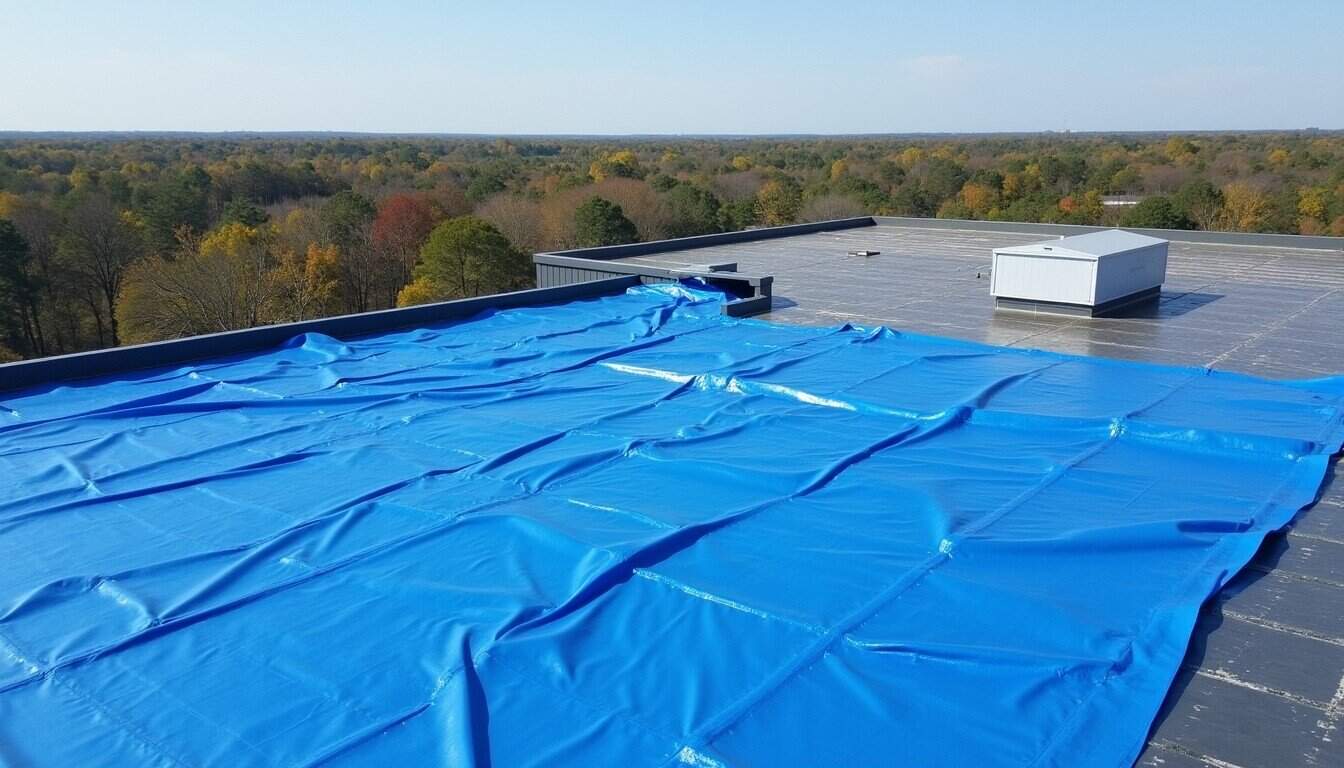
We triage dry-in and documentation as parallel workstreams when emergency conditions require it: a crew stabilizes the compromised zones with mechanically fastened cover board and temporary membrane while a second team documents the pre-repair condition. Every stabilization action is photographed before and after, and the temporary scope is documented separately from the wind-damage scope so neither set of documentation compromises the other.
After the building is stabilized, we complete the full zone documentation - photo log, fastener pullout probe, seam inspection at all perimeter terminations, edge metal condition, and parapet flashing status - and deliver the package to the building owner or property manager for claim submission. We do not submit claims; we produce the technical documentation that lets the claim move forward accurately.
Frequently asked questions
What wind speeds cause damage to Denver commercial flat roofs?
The design wind speed for most Denver commercial buildings under ASCE 7-22 is in the 115 to 120 mph ultimate design speed range, but field damage typically begins well below ultimate design loads when membrane systems have aged or were installed below the code-required perimeter fastener density. Chinook events sustaining 60-plus mph for extended durations - common several times per year on the Front Range - can drive cumulative perimeter fastener fatigue that produces damage without a single catastrophic gust. Microbursts producing 70-plus mph concentrated outflow over a small geographic area create the acute multi-directional loading that causes ridge-pattern tearing.
How do I know if my building's roofing system was installed at the right fastener density for Denver?
The as-built specification should include a wind-uplift calculation and a fastener layout diagram showing field, perimeter, and corner zone densities. If you do not have that documentation - common on buildings where the original contractor records are unavailable - we can perform a field fastener pull test that measures the actual resistance of the existing attachment pattern and compares it to the code-required value for your building's wind-exposure category. We include this assessment as part of any post-wind inspection on buildings where pullout appears to have occurred.
Can you do temporary repairs before the full wind damage scope is complete?
Yes. Temporary dry-in is scoped and invoiced separately from the damage documentation. We stabilize open areas with mechanically fastened cover board and temporary membrane, photograph every action before and after, and document the temporary scope independently so it does not create ambiguity in the wind-damage claim. The full documentation package is completed after stabilization.
Do you document wind damage for Colorado insurance claims?
| Scope Format | Written roof plan and photo record |
|---|---|
| Primary Market | Denver commercial buildings |