Saturated Insulation: Denver's Hidden Water Damage Accumulation
Water damage assessment and repair for Denver commercial roofs - snowmelt saturation, monsoon-season ponding, saturated insulation core mapping, and repair-vs-recover analysis for Front Range commercial buildings.
Water damage on Denver commercial roofs accumulates in two distinct seasons: the snowmelt period from January through April, when freeze-thaw cycling drives saturation into the insulation layer, and the July through August monsoon pattern, when brief high-intensity rain events overwhelm drainage on low-slope roofs. We assess both damage modes and scope repairs against what the moisture mapping actually shows.
Denver's semi-arid climate creates a counterintuitive roofing problem: because the air is dry, building owners assume that water damage is not accumulating. What actually happens on a low-slope commercial roof in Denver is that snowmelt cycles from November through April drive small amounts of water through compromised flashings and aging seams repeatedly over many months. Each event introduces a small amount of moisture into the insulation layer. Over a winter, the cumulative saturation can reach 15 to 25 percent of the insulation volume before any interior staining appears. By March, the freeze-thaw cycling has been turning that trapped moisture into an expansion-contraction engine that degrades the insulation facer bond, buckles the cover board, and accelerates deck corrosion on pre-1990 metal deck buildings.
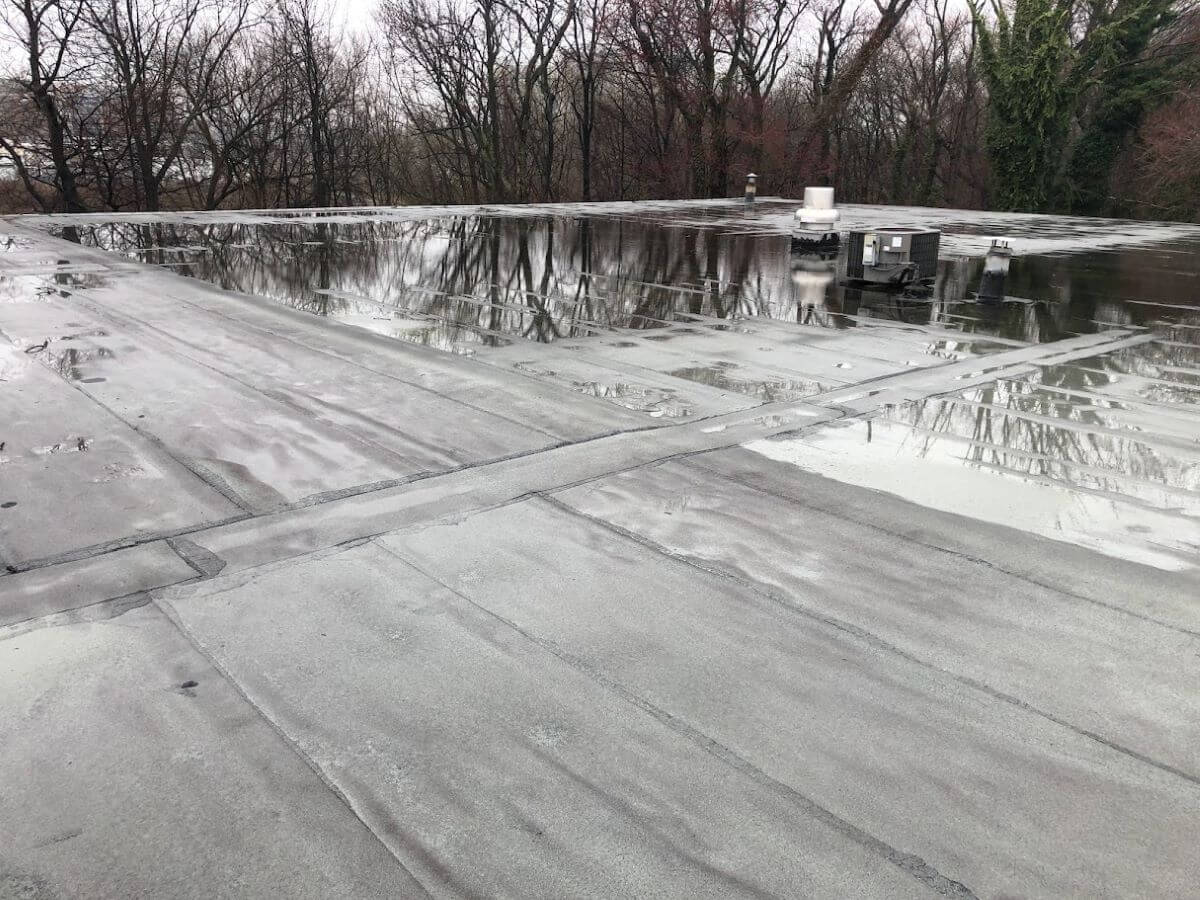
The July and August monsoon pattern adds a second water-damage mode. Denver's summer monsoon brings brief, high-intensity afternoon rain events - one to two inches in 30 to 60 minutes - that can overwhelm drainage on low-slope roofs with partially clogged or undersized drain systems. Ponding water that sits on a TPO or EPDM membrane for more than 48 hours after a storm event creates hydrostatic pressure at seams and penetrations that accelerates infiltration through details that handled normal precipitation without issue. Buildings with structural deflection - common on pre-1990 steel-deck buildings across the DTC and Stapleton districts - pond more than they were designed to and sustain more cumulative damage from each monsoon event.
We assess water damage on Denver commercial roofs with moisture cores and, where roof conditions support it, infrared thermography for saturation extent mapping. The repair-vs-recover-vs-replace recommendation is built on the moisture map, not on visual inspection alone - because in Denver's climate, visual inspection dramatically understates the saturation that has accumulated through a full snowmelt season.
Saturated insulation is the primary water damage mechanism on Denver commercial roofs - more consequential in the long run than most acute storm events. The pathway to saturation is slow and invisible: water enters through a failing flashing termination, travels laterally under the membrane, and accumulates in the insulation layer at low points and structural deflections. Because the membrane surface above appears intact and the interior shows no staining yet, the accumulation continues for months or years before it becomes visible.
Denver's freeze-thaw cycle converts saturated insulation from a passive problem to an active structural issue. Polyiso insulation - the standard cover board and insulation material on most Front Range commercial single-ply systems - loses approximately 30 percent of its design R-value when wet. When that saturated insulation freezes and thaws repeatedly through a Denver winter, the water expansion stresses the membrane bond above and the deck surface below. On pre-1990 metal deck buildings, where the galvanizing has worn and the bare steel is exposed at fastener holes and seam laps, corrosion accelerates rapidly under sustained saturation. We probe deck corrosion on every core pull that shows insulation saturation on buildings where the deck vintage makes corrosion risk plausible.
The repair-vs-recover decision for water-damaged Denver commercial roofs turns on saturation extent. We use a five-to-ten-location core pull grid - drain pans, parapet corners, mid-field, and any facility-manager-flagged stain locations - to map the saturation. If the saturated cores run below 20 to 25 percent of the total roof area, a targeted wet-tearout and recover can address the water damage without full replacement. Above that threshold on a building with aging deck, full replacement is the more defensible recommendation.
Monsoon-Season Ponding Assessment
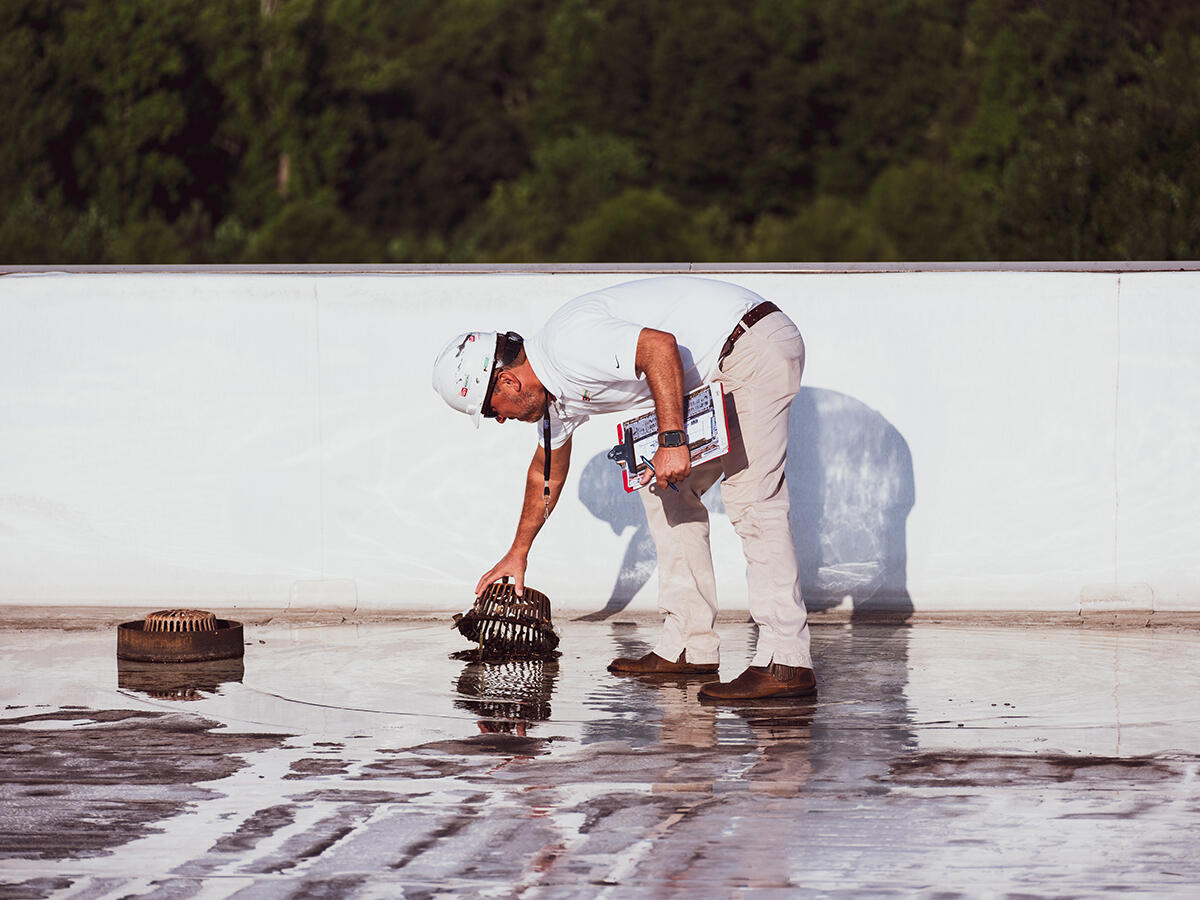
Denver's July through August monsoon season creates a ponding assessment window that does not exist in most US commercial roofing markets. After a significant monsoon event, a low-slope Denver commercial roof with drainage deficiencies holds water for 24 to 72 hours in structural deflection zones and at partially clogged drain sumps. That ponding window is the most useful time to map drainage deficiencies: we walk the roof 24 to 48 hours after a significant rain event, map every area holding standing water, measure depth, and identify the drainage pathway that is failing.
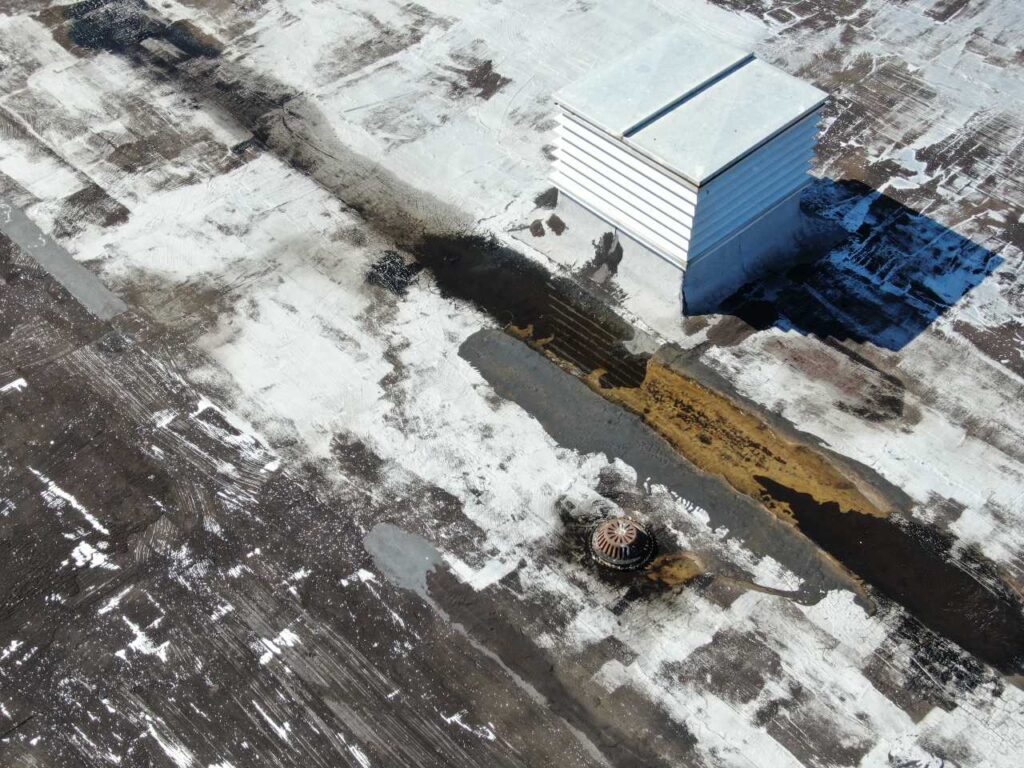
Drain clog and sump condition are the most common causes of monsoon-driven ponding on Denver commercial buildings. Cottonwood seed, roof gravel from adjacent buildings, and HVAC filter debris accumulate in drain sumps and on drain strainer baskets. Denver's cottonwood season - May and June - deposits enough seed material in open drain sumps to significantly restrict flow rates before monsoon season arrives in July. We document drain condition on every ponding assessment and include drain cleaning in the remediation scope where drainage is the primary ponding cause.
Structural deflection-driven ponding requires a different assessment. On buildings where the steel deck has deflected under decades of snow load, a drain that functions correctly at the original drain elevation now sits above the actual low point of the structural deflection. Water ponds between the drain and the deflection low point regardless of drain condition. We document structural deflection ponding separately from drainage deficiency ponding because the remediation paths differ: structural deflection requires tapered insulation fill or drain relocation, not just drain cleaning.
Frequently asked questions
How much snow load should a Denver commercial roof be able to hold?
Denver's ground snow load under ASCE 7-22 is 30 psf (pounds per square foot) for most of the metro. The flat-roof snow load used in structural design is typically 0.7 times the ground load - 21 psf - modified for roof exposure and thermal conditions. Buildings in the foothills communities west of Denver - Evergreen, Conifer, Golden - have significantly higher design values. If your building is showing structural deflection, cracking at parapet walls, or drain misalignment that suggests settlement, that is a structural review question before it is a roofing question. We flag structural indicators observed during roofing inspections and recommend engineering review where we see them.
Does saturated insulation need to be replaced, or can it dry out in Denver's dry climate?
Saturated polyiso insulation does not reliably dry out in place, even in Denver's low-humidity climate. The membrane above it limits drying to the edges and any open paths through the system, which are not sufficient to dry a saturated field area before the next moisture-introduction event. Partial in-place drying is sometimes achieved over a dry summer on edge-accessible saturation zones, but we do not recommend relying on passive drying as a remediation strategy. Core pulls that show wet insulation get a replace recommendation, not a wait-and-see recommendation.
How do you map water damage on a Denver commercial roof?
We use a core pull grid covering five to ten representative locations across the roof - drain pans, parapet corners, mid-field, and any facility-flagged interior stain locations. Each core is photographed and logged to the zone diagram. Infrared thermography is used as a screening supplement after clear nights when thermal contrast between wet and dry insulation is reliable. The core map, not the infrared alone, drives the saturation-extent estimate and the repair-vs-recover-vs-replace recommendation.
Can monsoon-season ponding damage a Denver commercial roof that was in good condition before?
Ponding water held for more than 48 hours creates hydrostatic pressure at seams and penetration flashings that can initiate infiltration through details that performed correctly under normal precipitation. A single season of repeated monsoon events on a roof with drainage deficiencies - clogged sumps, structural deflection low points - can introduce enough saturation to require targeted wet-tearout on a roof that otherwise had several years of remaining life. We recommend annual drain cleaning and a post-monsoon drainage walk on any Denver commercial building where ponding has been observed.
Suspected water damage on a Denver commercial roof?
Core pulls and a drainage walk give you the actual moisture map - not a visual estimate. We scope repairs against what the cores show, not what the surface suggests.
| Scope Format | Written roof plan and photo record |
|---|---|
| Primary Market | Denver commercial buildings |