Twenty-Four-Hour Operations and Production Sequencing
FM-approved assemblies, 24-hour operations coordination, and hail-impact documentation for large-footprint logistics buildings.
FM Global property insurance is the dominant coverage carrier for major distribution tenants in this corridor, and it requires FM-approved assembly specifications on all roofing work performed on covered buildings. FM approval is a system rating - the full assembly (membrane, cover board, insulation, fastener pattern, attachment method) must match an FM-approved assembly by number. Substituting an FM-approved membrane on a non-FM cover board and claiming Class 1 status is not compliant. We specify FM-approved assemblies by assembly number, document the number in the closeout package, and verify every delivered component against the approved configuration before installation begins.
The I-70 logistics corridor east of downtown Denver - running through Aurora and Stapleton toward the DIA cargo zone - is in one of Colorado's highest verified hail-frequency zones. The open-terrain exposure east of the urban core eliminates the wind-speed reduction that sheltered urban buildings benefit from. Wind-uplift design for distribution center buildings in this corridor requires ASCE 7-22 exposure category calculations specific to each building's footprint and parapet height - not a generic fastener density applied across all warehouse-type buildings.
Sysco Denver's Commerce City campus runs refrigerated food distribution operations with early-morning fleet dispatch beginning at 2 a.m. The refrigerated distribution bays operate at 35 to 38 degrees Fahrenheit and cannot tolerate unsealed penetrations during operating hours. We plan all Sysco refrigerated bay section work in defined daily windows - typically midday production that allows full dry-in before the late afternoon shift - with the refrigeration crew on standby for any penetration that cannot be completed as planned.
Walmart Distribution operates cross-dock and forward-distribution operations from its Aurora facility with strict inbound receiving windows that affect which sections of the building can be accessed for roof production at any given time. We map the dock position layout during our pre-construction walk and sequence production to work away from active inbound dock positions first, moving toward them as receiving windows close. The dock position map is part of the production schedule we submit before mobilization.
FM Global Specifications and Assembly Documentation
FM Global approval covers the full roofing assembly - membrane, cover board, insulation, fastener pattern, attachment method, and edge metal. We specify every component of an FM-approved assembly by FM approval number, not by product name alone. The FM Approvals database (fmapprovals.com) lists approved assemblies with their specific component configurations - we pull the current approval listing for each assembly we specify and include it in the project submittal package.
FM Global field engineering representatives periodically inspect covered buildings for roofing compliance. The closeout documentation we provide for distribution center projects is formatted to support an FM Global field inspection - assembly number, component manufacturer lot numbers, fastener density map, and edge metal attachment documentation. If an FM Global field engineer requests additional documentation after closeout, we respond directly to the request without routing it through the building owner.
Hail documentation for FM Global covered buildings follows a specific protocol. After a documented NOAA-verified event, the FM Global policy may require a certified condition assessment before any repair work is authorized. We produce condition assessments in the format FM Global field engineering accepts - photo log keyed to zone diagram, event date cross-referenced to NOAA storm data, and written scope distinguishing event-related from pre-existing condition.
Large-Footprint Roof Management and Inspection Cycles
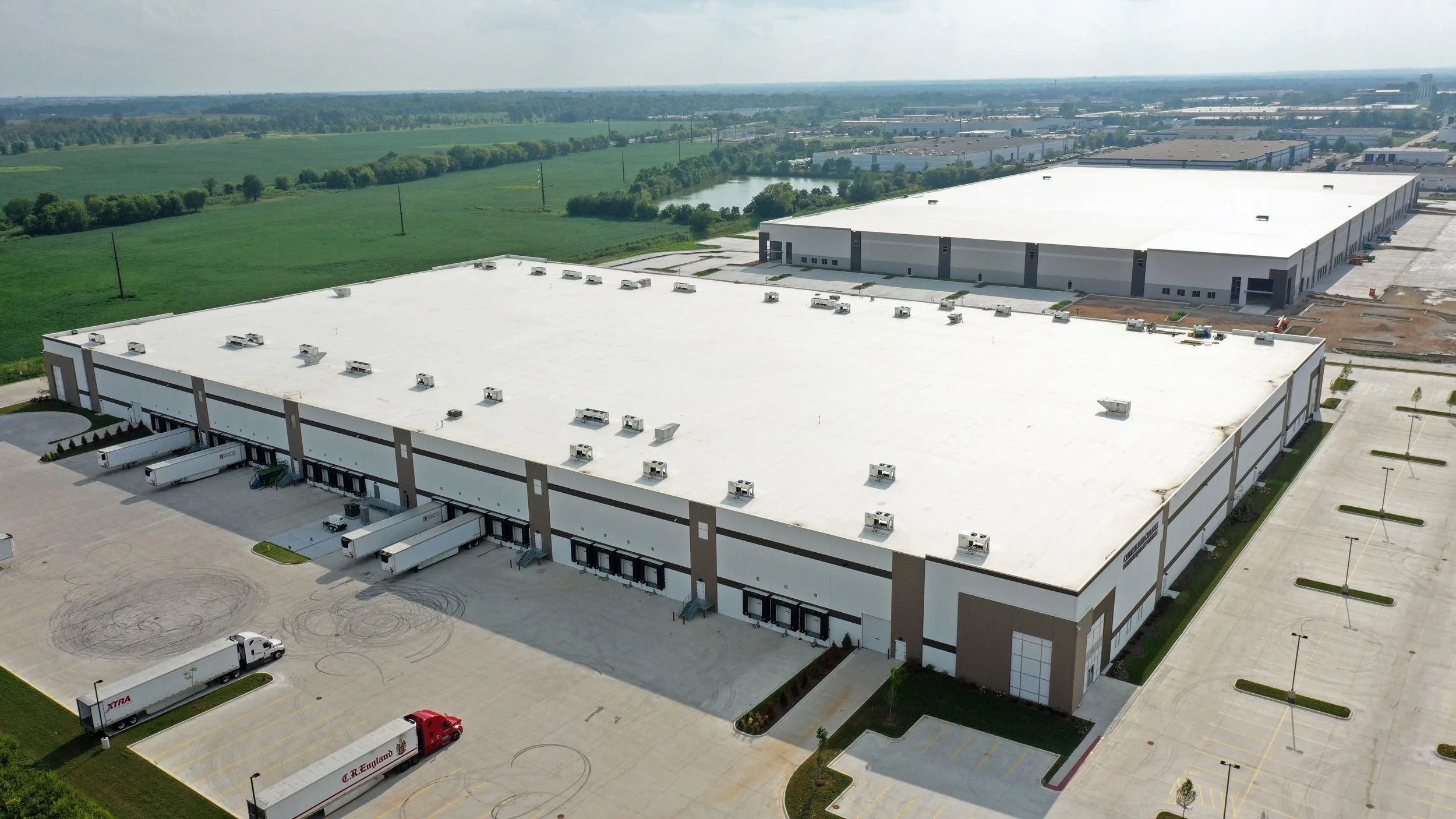
An 800,000 square foot distribution center roof has more square footage than some commercial districts. Managing these roofs requires a systematic inspection protocol - not a walk-and-look, but a documented zone-by-zone assessment with moisture cores at each drain pan, each low-slope pocket, and each prior repair location. We produce zone-keyed inspection maps for large distribution center roofs that become the baseline for every subsequent inspection, so that condition changes from year to year can be tracked against a consistent reference.
Drain management on large-footprint distribution centers is the most common source of preventable roof failures. The interior drain systems on 800,000 square foot buildings are large-diameter cast iron or PVC systems that require periodic cleaning to prevent the partial obstruction that, combined with Denver's 30 psf snow load design, creates structural ponding loads beyond the deck's design capacity. We include drain condition documentation in every distribution center inspection and flag partial obstructions for the facility's maintenance team with documented photographic evidence.
Frequently asked questions
How do you specify FM-approved assemblies for FM Global-covered distribution centers?
We specify each assembly component - membrane, cover board, insulation, fastener pattern, attachment method, edge metal - by FM approval number, verified against the current FM Approvals database listing. The approval number is documented in the project submittal and in the closeout package. We verify every delivered component against the approved configuration before installation and flag any substitution request for FM Global review before proceeding.
Yes. Operations calendar mapping during pre-construction identifies the low-activity windows for each building section. Production sequences away from active parcel processing zones. All penetrations are sealed same-day before peak processing windows open. We do not leave sections unsealed during active inbound or outbound sort operations.
How do you handle post-hail documentation for an FM Global covered distribution center?
We produce condition assessments in the format FM Global field engineering accepts - photo log keyed to zone diagram, NOAA storm data cross-reference, event-related versus pre-existing distinction, written scope. For buildings with FM Global coverage, we recommend contacting the FM Global field engineer before authorizing repair work, and we can provide the technical documentation that supports the field engineer's coverage determination.
What is your inspection cycle recommendation for a large-footprint I-70 corridor distribution center?
Semi-annual inspection - spring and fall - with a moisture-core protocol at each drain pan and prior repair location. The spring inspection documents winter snow load and freeze-thaw impacts. The fall inspection documents the summer hail season and prepares the drainage system for winter. Documentation from both inspections is formatted against the zone-keyed baseline map we establish at the first inspection.
Distribution center roof scope for your Denver logistics facility?
Our project managers will walk the full deck, document FM Global assembly requirements, and produce a written scope with 24-hour operations coordination plan - sized for the footprint and engineered for Denver's hail and wind exposure.
| Scope Format | Written roof plan and photo record |
|---|---|
| Primary Market | Denver commercial buildings |